Spring Term Artwork

Ben Zschunke, The Dreamer, 2009.


Ben Zschunke, Cait Rockwell, 2009.


Ben Zschunke, Roman Towns Wallpaper, 2009.


Ben Zschunke, Weather Wallpaper, 2009.


To the Naysayers and their Receptionists


Ben Zschunke and Rob Sterling, Inertia, 2009,
Tempera on canvas using a swinging brush.


As a human being living on this planet, floating throughout the vast cosmos, I somehow urge myself to be good, just, and virtuous using the unknown spiritual force that I may or may not possess within me. And sometimes rejection rears it's ugly face to turn me in other directions. But I must persist.


I dream sometimes. A year ago I dreamed of myself swinging from a giant horse hair rope in a gym over a canvas. The bottom of the rope drips with acrylic paint - thick blacks, blood reds, and gentle blues. And I swing to and fro pushing the paints across the canvas floor. The setup shown above represents a small scale realization of this idea.


I grabbed my paint brush in one hand and my friend, Rob Sterling, in the other. We squeezed color from tubes. We mixed them. We painted. I know some people in this world remind me to dig deeper into the art I make or see. And they know who they are. However, a brush, some color, a rope, a rod, and a Batman action figure made this piece alongside gravity and chance. How can anyone critique some of the most powerful natural forces? - "I'm sorry but gravity and chance did not perform well today." Ridiculous and absurd.

What does the future hold for art history?:
I bet this whole idea of art in my head will die. Everything I learned in art history will flee from my mind due to an ever changing concept of self. Constantly rebuilding itself. And finding a place for my art in the time line of the universe will be difficult, but I must try. Even if it's equivalent to a rat's hole in the wall of an old abandoned mansion where the foundation tilts with a gentle sadness. Or perhaps it's a place more like a blade of grass in a field, lost in a sea where billions of other blades die everyday without Earth shedding a single tear of sorrow.

So what happens now?
Currently, I find myself asking this question every minute of the day. And I always end in the same place. I'll just keep doing what I love doing, and that's shooting movies. As long as I have a passion than I see no reason for me to stop. Even if I die trying. Does it matter though? Yes. My love for filmmaking reaches farther than any realm known to mankind. And to succeed after rejection feels as good as revenge. So, be ready all you naysayers, your receptionists will have my name in "The Book of the Good, Just, and Virtuous".

I Am For An Art...


I am for an art that comes from within the deep, dark abyss of your soul and emerges as a phoenix from the ashes when it's wings show it marvelous color.

I am for an art that swings like a rope tied to a tree over one of the 10,000 lakes of Minnesota.

I am for an art who's eyes pierce the heart like a poison dart causing you to fall into a coma and dream for decades.

I am for an art that wears a mask from an uncharted land beyond the reaches of man.

I am for an art that moves at 24 frames per second.

I am for an art that lasts for hundreds of years but starts in the palm of a hand.

I am for an art who wakes up by my side with the sweetness of the sunrise kissing her cheeks.

I am for an art that lands softly on your shoulder and whispers sweet things in your ear.

I am for an art of solitude, alone and original, without the impression of society's deformed hand.

I am for an art that you aren't for.

I am for an art that turns it's color with the changing seasons.

I am for an art who welcomes you like a dog with his wagging tail in the doorway.

I am for an art who drinks soda pop and consumes burgers and rarely eats at home.

I am for an art who gardens with a tender smile and tough hands. Where a calendar holds no power and the only friend is the heavy air you breathe.

I am for an art that escapes judgment like the way trees creates leaves in the springtime or beavers construct dams in spite of federal regulations.

I am for an art who's masters look upon you and smile in memory of their younger years rather than sneer at the younger generation.

I am for an art who smiles in the face of the sorry folks who refuse to accept it, then holds it's tongue, and comes back, with great passion.

I am for an art that sticks it's middle finger up, strongly in the air, skewering the people who defy it in their sorry behinds.

I am for an art that sits in the stomach like a full meal but more like a passion that no one can remove, that no one can scathe, and that no one can poke at.

I am for an art that teachers refuse to teach.

I am for an art that knows no bounds and freely tramples the buildings of the past and blazes it's own trail.

I am for an art where plans boil down into a moment of time, captured on celluloid.

I am for an art who finds peace in the hollow, emotional darkness of death.

I am for an art that supports Mother Earth but defies Father Time.

I am for an art that doesn't understand the difference between good or bad, and right and wrong.

My Favorite Artists: Part Final

The first two artists were already mentioned on this blog. Here are the links for them:


The third and probably most interesting of the three changes the way humans will look at art. His name: Jason de Caires Taylor. His work stands above most artists that an art historian learns about because it actually stands below the surface of the water.

Off the coast of Grenada located in the West Indies, sits his museum of underwater sculpture. It's eerie feeling implies that humans will transform into nature after death. He embraces the transformations brought on by ecological processes.

Jason de Caires Taylor, Vicissitudes, Depth 4.5m, 26 life size figures, 5m diameter, Grenada, West Indies.

The underwater environment the optical perspectives change from that of being on land. Objects underwater appear 25% larger, and as a consequence they also appear closer. The light source in water is from the surface, this produces kaleidoscopic effects because of water movement, currents and turbulence. Also, as a malleable medium, water enables the viewer to become active in their engagement with the work. Some divers experience a "ghost effect" where they feel that they soar down like a ghost or angel looking down on these people.

Also, the surfaces of the sculptures constantly change effecting how the light plays on their rocky skin. It dances when the corral dies but when the corral thrives on the rock, the tone of the figures is a dark and moody one.

Jason de Caires Taylor, The Un-Still Life, 7.8m Deep, Grenada, West Indies
This effect also presents itself in Jason Taylor's The Un-Still Life where the traditional still life portrait remains still except for the fact that the corral life changes constantly without human interference but by underwater organisms.

But I think that Jason Taylor should receive a round of applause for expanding the confines of white-walled art museums and bringing art back to it's true origins, back in the hands of nature.

See more of Jason de Caires Taylor's Underwater Museum

Childhood

It's well known to those that know it well, that childhood is something that everyone loses. Something that we is given to us at birth and are stripped of permanently before we knew we had it. But who said we lost anything in the first place? At the same time, however, it would be dumb to say that nothing has changed. A weird predicament, indeed.

Jean-Baptiste-Simémon Chardin, The House of Cards, 1737

I remember in class, a picture of a boy building a house of cards. The surface content seems familiar, serene, perhaps even calming but with the passing of time the child's house of cards will inevitably fall. This idea of loss and destruction with the soft image of the child collide, exemplifying the loss of innocence.

There are many other pictures of this idea within the Rococo period of painting. What I find interesting though is that we might have not lost anything in the first place. Innocence replaced by experience. Unknowing filled by understanding. But then you could say that innocence and unknowing is better. But is it?

This proves a very trying question. What do you want out of life? I would pick truth. I have no reason why it appeals to me. Maybe because Cypher says mentions this in the Matrix (1999): "Ignorance is bliss". But I want to dive deep in life, more than living in ignorance, with a strong urge to learn and understand the universe. This maybe Romantic, but that's what I think.


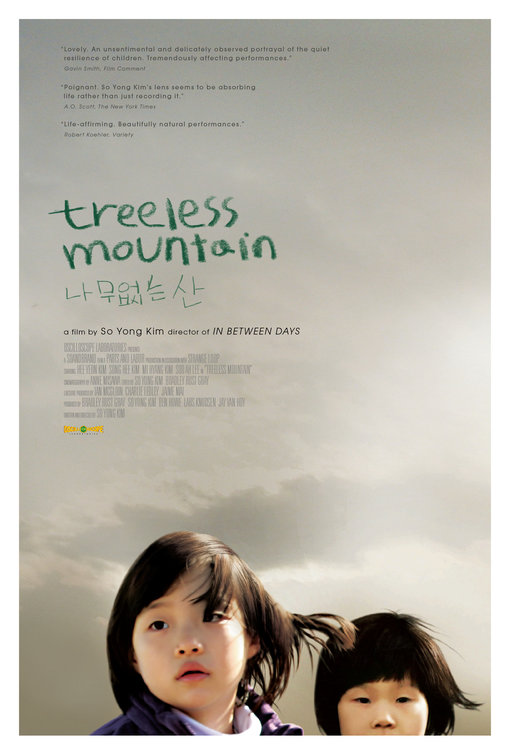
A movie that I saw recently at the RiverRun International Film Festival was Treeless Mountain (2008). Two young girls find themselves living with their drunk and ungrateful aunt, abandoned by their mother who disappears to find her husband. In this visually appealing film, the girls encounter many eye opening and innocence shedding experiences. Losing their mother, striving to become rich, the need for family, the need for food, the effects of alcohol, and the bitterness found in city life.

The South Eastern aesthetic presents itself in a new fashion in this feature by So Yong Kim. Although the compositions are flattened by long lenses, the natural lighting hails from European and American movies such as the French New Wave film, 400 Blows. South Eastern films generally feature the color black especially by crushing the shadows of the images, but this film's tonal range of color and shade go far beyond any South Eastern film I've seen. It seems like So Young Kim is absorbing the realism of the child actors rather than capturing it.


Treeless Mountain is truly a masterpiece and has captured the hearts of millions including mine.

Ben's Grade: A

Also read the review of 
Treeless Mountain from TinyMixTapes.com by Andy Lauer.

Found Item: Jacob

The People of China, Jacob, 2006-2009

It’s well known to those that know it well, that my computer is broken. Fractured for weeks. Cracked like glass. It’s face defaced. It cries for repair and love that I long to give it, but with out the proper screen, it will remain broken forever.

An ocean away, in a country grossly overpopulated but as comfortable to me as my own home, lives China. They build the world around me, and yet they don’t know me. And even though this barrier stands between us, I love them. Symbiotically. Like a child to it’s mother.

There is a story that I must tell that hasn’t ended yet, but I will tell it anyway. It is the story of my computer named Jacob.

THE STORY OF JACOB

Jacob, in the beginning, was nothing just like all things. He started out as an idea, conceived by an individual and nurtured in the womb. He was proposed on whiteboards, statistic spreadsheets, and blueprints. And for a while it was good.

Later, it was time for his birth. Many parts assembled themselves from the cosmos of the universe thousands of years ago, and congealed into a specific space on an assembly line. Metal and fire mostly. Jacob’s brothers and sisters were born before him the same way. But one day, Jacob was born from the same fire. His body, fresh. His skin, fragile. His brain, ready for learning. And for a while it was good.

The People of China looked upon Jacob and told him, “Jacob, we will send you away from home on an adventure to a new land called The United States of America where a young boy needs your help. Be good, Jacob.” The People of China closed the lid on his travel container and Jacob rested in on the soft Styrofoam in a silent, solemn slumber. And for a while it was good.

Eventually, Jacob arrived in Rosemount, Minnesota after hours of travel. However, Master was nowhere to be found. He asked the residence nearby where he went. They answered, “North Carolina.” So, he went. And for a while it was good.

Jacob arrived in Master’s arms the next day thanks to the U.S. Postal Service. Jacob and Master rejoiced and friendship was shared. They would experience many things together: drawing, Kittens Inspired by Kittens, long nights of homework, and 2girls1cup. But throughout their friendship they loved each other like brothers. And for a while it was good.

Then one day, Jacob and his master were watching a movie on the bed. Master was preoccupied and bumped Jacob off the bed. Jacob fell looking up at Master’s horrified face screaming, “JACOB! NO!” But Jacob didn’t say anything, as if all the effort that it took for him to be created, for all the time it took for him to get to North Carolina, and for all the memories that he had with Master, he said nothing. Then, Jacob plainly hit the ground causing much harm to his face. Master picked him up and cradled him, and there was much shedding of tears that night. This time it was not good.

Today, Jacob sits in a vegetable state. Only his memories are accessed. And Master doesn’t use Jacob anymore. Jacob longs for Master’s touch or maybe watching another movie sometime. But he cannot see. Jacob is blind and disfigured.


If only a computer could heal like a human can heal. As if the screen had only some gashes that would heal after a topical application of Neosporin and a Band-Aid only leaving a minimum amount of scar tissue.

Maybe someday he will be able to do all those things again. Maybe so. Maybe he will go back to the People of China where he will be disassembled into nothingness again. And maybe then he will be reincarnated and shipped to another master who will love him better. Maybe, just maybe.

In memory of Jacob
May he rest in peace.

Two Ties and a Funeral Jumpsuit


Kim Zschunke, Ben, John, and Betty, 2000.

It's well known to people who know it well, that an old person's wondering stare kills and my great uncle Ben seems to have mastered the technique.

This picture, captured at the funeral of my Grandmother in a church lobby, began a new chapter in my father's life. John, the name my father calls himself, stands strongly between his two elderly godparents, his hands firmly on their shoulders, comforting them, but as a constant reminder that as a member of a younger generation, will outlive them. A sad but honest reality that Ben and Betty now realize.

But John's smile tells more than the rest of him. For all my life I've been close to my father. He taught me more than I realize. His humor, his posture, what to do with my hands when I find myself bored. This telltale smile is another thing my dad taught me. His lips curl under and rise, giving his cheeks a lift as well making them puffier consequentially making his eyes squint. His tears for his deceased mother would roll forth if not for the camera for which he smiles.

But possibly, he tears for his own health. The onset of Alzheimer's has already claimed Ben's mind along with John's father, Don. With this, John thinks of his own ending as well. Ever since this day, my father fights the onset of Alzheimer's in fear of his own life but because he fears what he sees in his father and Ben. And I fight along side him. I have seen the horrors of old age and I fear it as well.

I know for a fact that Uncle Ben thought about his own death. I remember talking to him that day: his eyes glistened with tears but they were wide with hope. "Maybe I won't die," he thought. But alas at this moment, his inevitable demise sunk in, his head fell in defeat, his eyes focused on something unseen and distant. He tries to smile, but falls short of a smirk under the weight of his wrinkled skin.

Betty on the other hand, looks to her husband through her brown sunglasses. A punctum of sorts. It amazes me that she of all people would wear sunglasses indoors. Years play heavy on her body and she wears bright, outdated jumpsuits to funerals, I wouldn't think that she would wear glasses. Perhaps they are a shield, like my dad's smile, that block onlookers from seeing her tears if they decide to flow. But at this moment, she smiles with happiness and a certain pride that runs unmatched with Ben, perhaps for the life they lived together for so many years.

A famous person once wrote, "...in the photograph, I read an air of goodness. Thus the air is the luminous shadow which accompanies the body; and if the photograph fails to show this air,...there remains no more than a sterile body." It is this that I agree with Roland Barthes, that an air of goodness surrounds these subjects. Some family bonds rekindling from years of absence in memory of a fallen relative. You can find good in death, in a room with finger sandwiches and neutral walls. With both old and young people where ideas of the afterlife flow without words but are shared though the eyes of the wise.

I really like this photograph, if I haven't said so yet. But I find punctum in this photograph that I never even knew about when I was at the funeral. The way Betty holds her hands, crippled with arthritis. The way Ben stands straighter than an arrow. The way Betty's purse lies on the ground in the background. I hope John helped her put it down.

This picture will continue to be part of my life, not just because I like it, but because it reminds me of what I want love to be like. Wholesome friends and family, standing side by side, in times of sadness and death.

My Favorite Artists: Part 2

Elizabeth Peyton, Live to Ride (E.P.), 2003


Elizabeth Peyton remains another one of my favorite contemporary artists. Her simple paintings and vivid colors capture my attention among the grayish city life that I live, but as I spend more time with her paintings I begin to feel something we've talked about in class.

I had found the person that best displays the modern world. Her tribute to modern art reminds me of Monet with splashes of expressionistic qualities as well. But I have a hard time relating to the paintings of Monet because it brings an emotion of nostalgia toward the innocent and more simplistic aspects of the 1800s. But as for the present, I feel that Elizabeth Peyton has captured the modern individual in these snapshot-like paintings.


Elizabeth Peyton, Prince WM and Prin Harry, 2000.

Her simple paint sketches remind me of impressionism. The hard brush strokes, the bright colors, the attention to light. All of these show themselves in Peyton's Prince WM and Prince Harry (above). But the color warps into an unrealistic realm where imagination and emotion live. Layers of color overlap each other creating depth on a single plain of focus. This is one of my favorite parts of Elizabeth's work.

The flatness of her images allude to artists that precede her but her style of flattening transcends that of Andy Warhol's hollow copies or Roy Lichtenstein's comic book look-a-likes. Her lines and colors together create a beauty far more grand than any postmodern artist could reach. Her attention to a shared humanistic beauty between all her subjects fills my eyes giving me hope rather than just presenting what the modern world looks like.

Elizabeth Peyton, Nick and Patti, 2007

There is no telling where Elizabeth will end up in the next few years and I will definitely have my eye on her work through the changes that inhabit the art world today.

To learn more about Elizabeth Peyton and her work, please visit her Walker Art Center Gallery Page. And to listen to her talk about her art, visit New Museum's Audio Interview with her.

River Run Film Festival: 500 Days of Summer


Normally, a very small amount of student films find their way to the screens here at UNCSA. Partly because of the fleeting budgets for film production due to the economy. Even though this cannot be controlled by the School of Film, it makes the filmmakers detached from the rest of campus. But with the arrival of the 11th Annual River Run International Film Festival, it makes the school of film far more vibrant than most days. And this year it kicked off in high fashion.

Yesterday, on Wednesday, the 22nd of April, Fox Searchlight's
500 Days of Summer (2009), directed by Marc Webb, screened at the Stevens Center in downtown Winston Salem. The story seems like a normal boy-meets-girl romantic comedy featuring two lovely characters: the lovely new secretary at a greeting card company, Summer (Zooey Deschenal) and bored greeting card writer, Tom (Joseph Gordon-Levitt). But 500 Days of Summer bends and breaks most, if not all, the romantic comedy stereotypes.

The story is full of romantic truisms, rather than using more formulaic storylines, which most of us have experienced but we keep secret due to their darker nature. Break-ups, confusion, and loneliness are all too familiar to Tom's world as he fights past the "friend-zone" to get Summer to love him again. But writers Scott Neustadter and Micheal H. Weber are not afraid to venture into these topics even if they are somewhat based in their own reality. Marc Webb even stated in the Q&A after the screening that he sees a lot of himself in the character Tom.

The film also takes the audience on an unexpected visual journey. Many alliterations to old foreign films such as
The 7th Seal and Masculin Féminin give a nostaglic feeling that Marc Webb, the director, also mentioned in the Q&A. This feeling was also captured through it's use of neutral colors and plain wardrobe which reminded me of what Revolutionary Road achieved. Marc Webb further explained the use of blue as the only primary color, which was inspired by Zooey Deschanel's eyes, that found it's way into most of the film's most passionate moments like the musical number where Tom dances on his way to work after a successful night with Summer.

I don't want to give away the ending, but this film takes risks on the balance beam between love and friendship, passion and depression, and sanity. It will take your heart for the ride. It's perfect for a date movie and great to see with a group of friends or even alone; to mend a recent heartbreak or to have a good laugh.

Even for a summer flick, this film is definitely a head-turner that will catch audiences' hearts and affection this summer when it comes out in select theaters on July 20th.

Ben's Grade: A

Visit the official Fox Searchlight website for
500 Days of Summer. Or visit the IMDb webpage to learn more about the film.

My Favorite Artists: Part 1


Tetsumi Kudo, Cultivation - For Nostalgic Purpose - For Your Living Room, 1967 - 1968

When I think of postmodern art, I think of Andy Warhol, Jackson Pollock, and Roy Lichenstein. But one name that slips the list is Tetsumi Kudo, my favorite artist at the moment.

His work covers many types of media: video, photography, painting, sculpture, installments. I visited a gallery of his best work at the Walker Art Center in Minneapolis, Minnesota this past spring break. A Walker employee told me it was Kudo's first U.S. solo exhibition.


Tetsumi Kudo, Your Portrait - Chrysalis in the Cocoon (Votre portrait - chrysalide dans le cocon), 1967

As an artist he started in Japan but found little success until he ventured to France where he spent a majority of his life. His work was unlike most postmodern artists of his time which draws me closer as a Tetsumi Kudo enthusiast. He bridged French Nouveau Realisme, International Fluxus, Pop art, 1960s anti-art tendencies, and 1980s Japanese postmodernism all without specifically belonging to any of them.

Just because of this fact his "idol-factor" has raised in my book. To be a great artist but belong to a genre entirely to yourself is quite a feat.

I enjoy the mess of brightly colored yarn, tangled in bones and brains. The cross-breed of male genitalia and caterpillars make me laugh but also tell me to step back and think about what they actually mean. Are they a reminder that I am just like an animal? Am I really that close to nature? Do I have caterpillars in my pants?

His work consisted of Post-WWII destruction that many Japanese artists moved to after the dropping of the atomic bombs, but Tetusmi Kudo brings new life to the idea. His work blends the Japanese destruction with the oneness of humans -- that all humans will die eventually, that through love can we truly be happy, and the belief in humanity will unlock many doors that have remained closed since the beginning of time.

I have a hard time talking about an artist that I love, because I want to keep the artist in mystery. And I find Tetsumi Kudo one of these artists that have risen to the top of my list. But there may be some expansion on this later.

To read more about Tetsumi Kudo and to see more of his work visit The Walker Art Center.

Art, Money, and Meaninglessness


Flyer from Local Art Gallery at Krankies Coffee

As my friends and I walked through the gallery at Krankies, we found some very simple art. Paint on wood, cloth stapled to styrofoam, broken skateboards, pen drawings. This just makes me think of how much I could do this. I could be a gallery artist, no problem.

We added up the total amount of money that this artist, Zap, was going to make with his sold items. It totaled up to $1436. That's enough money to pay for a loft in downtown Winston Salem for 3 months. Some meaningless art pieces for some hard cash. I would like that.

But is there such a thing as meaningless art?

For examples, these umbrellas are somewhat meaningless. Yes, they are cool and interesting and intriguing. But the umbrellas sit on the ground, littering the earth, the same as your water bottle, fast food containers, and paper coffee cups. It's interesting to think of junk as art and art as junk. Although, I bet this is a better life for these umbrellas. Unique among many. Unified with their brothers and sisters.

Perhaps this is a new way to distribute umbrellas. Instead of purchasing one, just have an Umbrella Ball that people could rent one when it rains. No one would own an umbrella but would only take one when it's raining, then replace it in another Umbrella Ball in the city. Sort of like airport luggage carts.

So maybe these umbrellas aren't so meaningless after all. They give us ideas about the flaws in our world and how to improve them.

Web 3.0?

Check out this new operating system. I hope I can afford this when it comes out. This reminds me of so many movies. It's so innovative and interactive. I can't wait!

Still Life Photography


Terry Evans, Field Museum, Swan, 1891, 2001

This photo brought up some interesting questions today in class. I would just like to address them. The questions were:

1.) Does this image startle you?

At first, it was, however after it sunk it, I realized it's elegant beauty in the way the swan was wrapped and preserved. Immediately I thought it was either a lunatic that was preserving it or a museum. And in fact it lives in a drawer in the basement of a museum. I just want to reach out a touch it's soft feathers and pretend that it will wake from it's solemn slumber and open it's gently closed eyes.

2.) Is this art, documentation, or scientific?

This is probably my favorite question. A lot of students were having trouble with it, but as for me I see it simply through a thought process. Here's an illustration:


There are somethings that need clarification in this flow chart. Like photography and film, although popularly acclaimed, is not considered as arty as painting.

This bothered me especially in class today when Kelly explained that she thought that the swan was not art. Why, I ask? Because it was not intended to be art? Well it was. Well, it's not art because it's real. Well, so is a statue. Is a photo of a brain art or documentation? Both.

The thing is Kelly, is that art is far more expansive than you think. It's everything and anything you want it to be, even meaningless things.

Also, I would like to add that a majority of great filmmakers (cinematographers especially) make commercials for a living. It's a well paying job. Who's going to say that ads can't be art as well? I hope not any of you, because then you'd be saying that I'm not an artist. I mean, it's cool, then I'll just say that you're not a critic.

I always wondered what it would be like to create a piece of art that would be so ridiculous that people would believe that I was completely out of my mind. I think I will. And I hope I get the reaction I'm looking for. Be ready art history class.

Also, I think art history has been better as a means of finding my style rather than writing about art. I mean, as long as I can create, even building upon previous ideas, then what else matters?

An Introduction

Art: the process or product of deliberately arranging elements in a way that appeals to the senses or emotions.

I like the way Wikipedia and I have joined forces to bring up a dilemma with this definition:

In Modernism, this definition will be challenged, questioned, and disputed. At the simplest level, a way to determine whether the impact of the object on the senses meets the criteria to be considered art, is whether it is perceived to be attractive or repulsive. But this is subject to experience and anything not attractive to an individual wouldn't be art but could be beautiful to another.

However, "good" art is not always or even regularly aesthetically appealing to a majority of viewers. In other words, an artist's prime motivation need not be the pursuit of the aesthetic. Also, art often depicts terrible images made for social, moral, or thought-provoking reasons.


Francisco Goya, The Third of May, 1808, 1814


For example, Francisco Goya's painting depicting the Spanish shootings of 3rd of May 1808, is a graphic depiction of a firing squad executing several pleading civilians. Yet at the same time, the horrific imagery demonstrates Goya's artistic ability in composition and execution as a painter and political activist. Thus, the debate continues as to what mode of aesthetic satisfaction, if any, is required to define 'art'.

This is the question that I seek to answer in this blog. To define art (or to stop the definition). I will answer it in writing, examples, and in art pieces that question what art is.

I hope this works.